



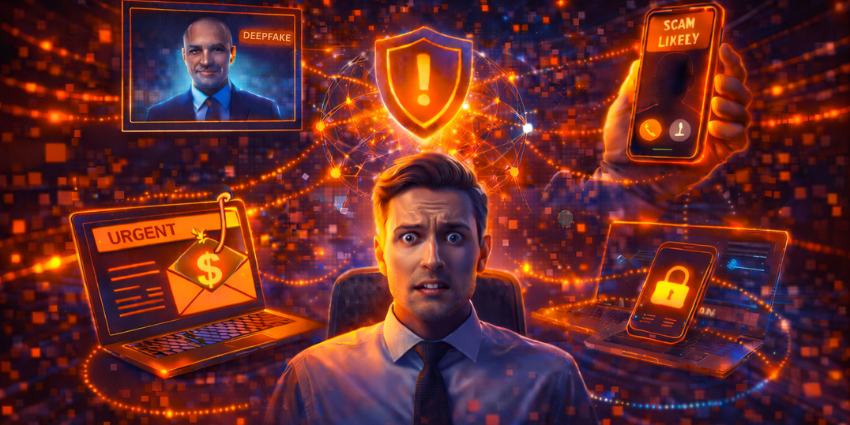
Workplace communications are built upon a foundation of trust – but that trust is now being exploited by UC deepfake threats and other forms of malicious synthetic media.
Synthetic media is no longer theoretical. It is being used in real-world fraud, impersonation, and deception. For enterprise buyers, this changes how future UC security platforms must be evaluated.
These cybersecurity risks should be top of mind when considering what a next-generation protective layer will look like. The risk of inaction is significant financial and reputational losses.
Below are three distinct forms of synthetic media: voice, video, and disinformation, and how each is reshaping Unified Communications risk.
Related Articles:
UC Deepfake Threats: Voice Fraud
One of the most established forms of UC deepfake threats involves synthetic voice cloning. AI can now replicate tone, cadence, and accent well enough to deceive employees during live workplace calls.
For example, in 2019, criminals used AI-generated voice technology to impersonate a C-level executive. From there, they persuaded UK-based business partners to transfer USD $240,000 to a fraudulent bank account, the Wall Street Journal shared
As AI in collaboration enhances call clarity and removes background noise in platforms such as Microsoft Teams and Zoom, synthetic media risk becomes harder to detect. Furthermore, UC technology is only becoming more commonplace and trusted across the globe.
Future UC security must prioritize voice fraud security through:
- Behavioral voice biometrics.
- Real-time participant verification.
- Context-aware anomaly detection tied to financial workflows.
These threats prove that voice identity inside Unified Communications cannot rely on human judgement alone.
UC Deepfake Threats: Video Conferences
UC deepfake threats are also expanding into video.
In 2024, a Hong Kong-based multinational firm reportedly lost approximately USD $25 million to deepfake video, according to Financial Times. Attackers used deepfake images and cloned audio to impersonate senior executives and acquire a hefty sum.
When employees believe they are in a legitimate internal meeting, it is the ideal situation for bad actors to deploy deceptive technology. Video is no longer proof of authenticity.
Future UC security must include:
- Strong authentication before high-risk meetings.
- Detection of manipulated audio and video streams.
- Governance controls for financial approvals conducted within UC platforms.
The proliferation of AI is changing workplace security policies, particularly around meetings. UC Today explored this phenomenon and set out best practices for IT leaders in a recent explainer.
UC Deepfake Threats: Misinformation and Email Fraud
The third and most persistent form of UC deepfake threats involves email-driven wire fraud that flows directly through the Unified Communications ecosystem.
In a high-profile case, a malicious actor created fraudulent invoices and sent them to Google and Facebook. Posing as one of their partners, he duped the companies into transferring over USD $100 million, The Independent reported.
While this case did not rely on deepfake audio or video, it demonstrates how synthetic media risk in written form can infiltrate enterprise communication channels. Email remains tightly integrated with the UC stack. Invoices, approvals, and payment confirmations often move from email into chat, calls, and meetings for validation.
And with the increasing capabilities of AI, attackers can easily generate highly realistic supplier correspondence, mimic writing styles, and align messages with real procurement cycles. In a legacy UC environment, a fraudulent invoice email may be discussed in a Teams chat, mentioned in a video call, and approved via a workflow tool – within minutes.
Therefore, forward-thinking UC security leaders must consider:
- AI-driven phishing detection integrated with collaboration tools.
- Verification controls for invoice and payment approvals.
- Cross-platform monitoring of suspicious communication patterns.
When email is integrated into Unified Communications workflows, a convincing digital impersonation can scale rapidly.
Future UC Security Must Be Cross-Channel
UC deepfake threats are reshaping enterprise risk across voice cloning, video manipulation, and AI-enhanced phishing. Real-world cases show that financial loss and reputational damage are already occurring.
Future UC security must connect identity verification, media validation, and workflow monitoring across voice, video, messaging, and email. For enterprise buyers, the message is clear. Evaluate vendors based on how well they address UC deepfake threats across the entire collaboration environment.
In this era of synthetic media, trust inside Unified Communications must be engineered end-to-end.
FAQs
- What are UC deepfake threats?
UC deepfake threats refer to AI-generated or digitally manipulated voice, video, or written communications used to impersonate individuals within Unified Communications platforms, increasing synthetic media risk. - How does voice fraud security relate to UC deepfake threats?
Voice fraud security focuses on detecting and addressing AI-generated voice impersonation during calls and meetings within the UC stack. - Why is email fraud relevant to future UC security?
Email fraud is relevant because email is integrated into Unified Communications workflows, and AI-generated phishing can trigger fraudulent actions across chat, voice, and video channels
For more insight into the future of workplace security, check out our Ultimate Guide to Security, Compliance, and Risk.
To keep up to date on the latest news on UC innovation, follow us on LinkedIn.
Read the full article here